
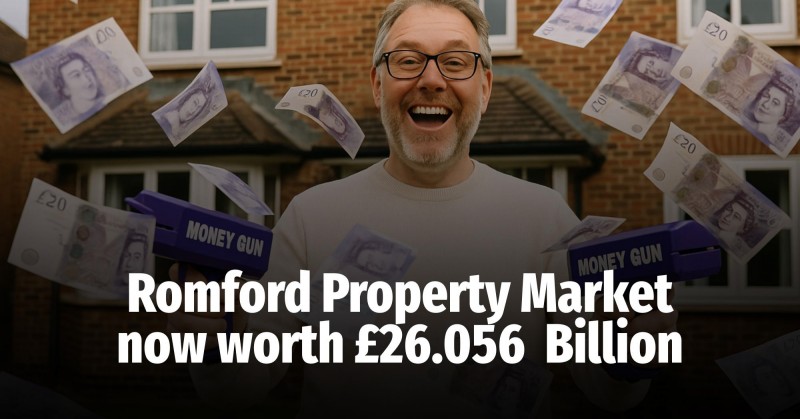
As we hit the third week of December, the Romford property market does slow down ready for the big day. It’s at this time of year, I like to work out the total value of every home in Romford, and how that value has changed since 2010 (as that was the bottom of the market after the Credit Crunch). During those years, Romford has gone through market cycles, mortgage booms, periods of national uncertainty, political shifts, and economic swings. Yet when you step back, the story is simple. Romford housing wealth has risen markedly.
In the last 15 years, the total value of Romford housing has risen by 106.5%, from just over £12.618 billion to around £26.056 billion.
That increase has been created simply because homes in the town are now worth more than they were. For freehold owners, that growth has happened whether they renovated the kitchen, extended the lounge, or did nothing at all.
To put that into some form of understandable scale, if Romford’s property wealth were a company listed on the UK stock market, it would sit comfortably in value between Prudential and SSE corporations. It would be comparable in value to household-name businesses employing thousands of people. The difference is that the value here is not held by investors or shareholders, but by thousands of ordinary Romford households.
That alone changes your view of the place we live.
Over the same fifteen-year period, the FTSE 100 has risen by 69.5% and UK retail inflation has risen by just over 55.9%.
When you look at the average price paid for a Romford home
over the last twelve months, the figure sits at £434,274.
However, averages always mask the real story, so I split the town into its main property types. That is where the differences become clear.
- Detached homes in Romford currently have an average value of around £644,823. Across the housing stock, that equates to just under £3.220 billion of housing wealth held in detached homes alone.
- Semi-detached houses in Romford currently average £522,026, representing over £10.014 billion of total value.
- Terraced and townhouses in Romford sit at an average of £441,883, collectively equating to £8.650 billion.
- Flats and apartments in Romford average £245,325, representing £4.171 billion.
Whether you own a flat, a terrace, a semi-detached, or a detached Romford home, you hold a share of something that has grown steadily, even when national headlines have been turbulent.
This matters not only to homeowners, but also to those renting in Romford. Renters often feel the market works against them, yet the fact that total housing wealth has increased means something further. Owners have more equity than before, buyers have higher deposit hurdles, and renters face rental levels shaped by the wider increase in market values.
A significant portion of families renting in Romford are doing so not because they are unable to buy, but because the pace of deposit saving has been slower than property price growth. When homes rise at a rate faster than wages, the deposit gap widens, which is exactly what has happened since 2010. That can understandably feel frustrating.
Yet renters have also benefited indirectly. When areas consistently grow in value, investment follows. Better retail, stronger schooling demand, upgraded facilities, more employers moving in, and regeneration funding all tend to arrive in places where housing value remains resilient.
The strength of local Romford values is not just about bricks and mortar, but about the attractiveness of the town itself.
Romford’s appeal has been shaped by a mix of long-standing fundamentals. Good transport links, a growing education base, and continuous residential demand have helped. Families tend to move in, stay for many years, move once or twice locally, and that leads to demand stability.
Meanwhile, supply has not kept pace. Many will comment, with justification, that parts of Romford have felt like building sites in recent years. Yet when compared to need, the number of new homes delivered has been insufficient. Every year, the number of household formations exceeds the number of completed additional homes. That ongoing shortage acts as a support for existing values.
The mortgage market also plays its part. Rates are still higher than the record lows of a few years ago, yet if you zoom out historically, borrowing remains reasonable. Households that bought ten or twelve years ago often remortgage today against dramatically increased equity. In many cases, that equity allows extensions, upgrades, or even assisting children with deposits.
The ironic outcome is that rising wealth benefits those already on the ladder far more than those wishing to climb onto it. That is not unique to Romford, but Romford illustrates it clearly.
What makes Romford’s housing market particularly
interesting is how wealth is spread.
There is no single neighbourhood that holds most of the value. The billions of pounds of property wealth are split through detached streets, Victorian terraces, 1960s estates, modern developments, flats above shops, edge-of-town family homes, and older stock around historical streets.
When you picture £26.056 billion, it is easy to imagine vast commercial buildings or major institutions. Instead, it is held in living rooms, gardens, driveways, converted lofts, extensions, and family homes that have been bought, sold, rented, and inherited across generations. Demand remains steady, supply remains tight, employment remains stable, and sentiment improves whenever inflation cools and interest rates soften.
We should remember something. Property value is not created in isolation. It exists because thousands of people prefer to remain here rather than leave. Values rise because Romford families choose to stay, buyers choose to move in, and landlords continue to invest. If all that energy ever reversed, values would fall. The fact that values have continued to rise across fourteen years shows that the town has not lost its appeal.
Whether you own a Romford home, rent one, or are thinking of moving, the reality is that Romford holds billions of pounds of residential wealth, and that wealth is likely to remain resilient. Anyone can check the value of their own home at any time, but sometimes it is useful to zoom out and look at the bigger picture. It tells you far more about stability than short term house price headlines do.
If you are curious how your Romford home fits within that wider story, or if this raised questions about buying, selling, or renting locally, feel free to get in touch. A conversation costs nothing, and sometimes one number or one insight can help you make choices that shape the next decade of your life.